
Stansted Airport
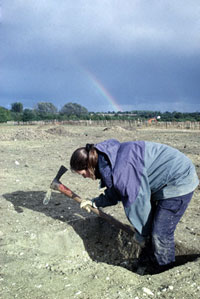 Between 1999 and 2004, Framework Archaeology undertook a series of large-scale archaeological excavations at Stansted Airport, Essex. These were undertaken in advance of redevelopment work within the Stansted Airport Limited landholding. The developments were designed to improve facilities for passengers or to augment the infrastructure of the Airport.
The results of the archaeological excavations were published by Framework Archaeology in 2008 in the book entitled “From hunter gatherers to huntsmen: A history of the Stansted landscape”( Framework Archaeology Monograph No. 2.). It is available to buy from Oxbow Books.
Read more about this book.
Download the excavation data
 You will need to download the following two files:
- View the digital archive and the web-based GIS at the Archaeology Data Service
- The Framework Free Viewer (our free archaeology data viewer: Windows, 3.2MB)
- Stansted Archaeology Data (to load into the Free Viewer: 342.6MB)
Reports and Raw Data
- Download the specialist reports (Zipped PDF, 40MB)
- Raw data downloads (for advanced and non-Windows users: csv, xml, gml, shp, data dictionary, photos, sections)
- Data download support (see links on right of the page)
Data License

The Archaeology Data and raw data downloads are licensed under a Creative Commons Licence.
Archaeology
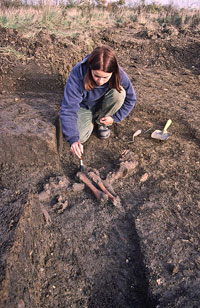 The earliest evidence for human activity indicated that the area around the airport was visited by transient hunter-gatherers. The inhabitants of the area introduced small-scale agriculture in the Neolithic and Early Bronze Ages and began to occupy permanent settlement with domestic structures in the Middle Bronze Age. An important enclosed settlement of that date was excavated.
There was coherent enclosure of the landscape and increased settlement density in the Middle and Late Iron Age. Under the Romans, there were changes in burial practice and settlements established in the Iron Age declined and some were abandoned. An apparent resurgence in activity in the 4th century may be linked to the creation of large agricultural estates.
In the post-Roman period much of the area reverted to woodland. By the Late Saxon period farmers again cleared areas off woodland for agriculture. Villages sprang up in river valleys and along the Roman road network. Evidence for medieval settlement, farming and assarting, and for the location of Stansted Park and a hunting lodge was uncovered.
Book: From Hunter Gatherers to Huntsmen - A History of the Stansted Landscape
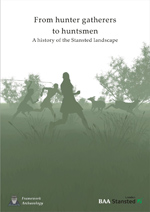 The expansion of Stansted Airport provided an opportunity to investigate a large area of clay plateau, typical of the north-west Essex landscape. The area was a focus for hunter-gatherer activity as early as the Palaeolithic period, and was first settled by small farming communities in the Middle Bronze Age. From the Middle Iron Age onwards, increasing settlement and population density led to the enclosure of the landscape. Farming and settlement concentrated on the more fertile river valleys and the slopes of the heavily wooded plateau.
The Romano-British period saw a decline in the rural population, whilst increasing agricultural intensification led to the first systematic farming of the clay plateau. Woodland regeneration in the post-Romano-British period is clearly demonstrated in documentary sources. Indeed, much of the history of the Saxon and medieval settlement of the area concerns the relationship between agricultural expansion and the surrounding woodland, whilst deer parks such as Stansted Park allowed landowners to demonstrate their mastery of the landscape and its wildlife.
This book, along with its accompanying CD-ROM, presents the results of these excavations, allowing the reader to explore both broader historical themes and the minutiae of individual sites, features and finds. The results of earlier work in the area are integrated, providing a coherent historical narrative of human inhabitation.
Order this book from Oxbow Books.
© 2009 Framework Archaeology