
- This website reflects our views on the Terminal 5 site based on many years of post-excavation analysis, which culminated in the publication of the final volume of the T5 report in 2010.
The Heathrow Landscape
How do we know this?
Find out more details in our archaeological evidence sectionHeathrow Airport
The Archaeologists
Framework Archaeology
Tag Archives: forest
8,500-4,000 BC Deep Forest and a River
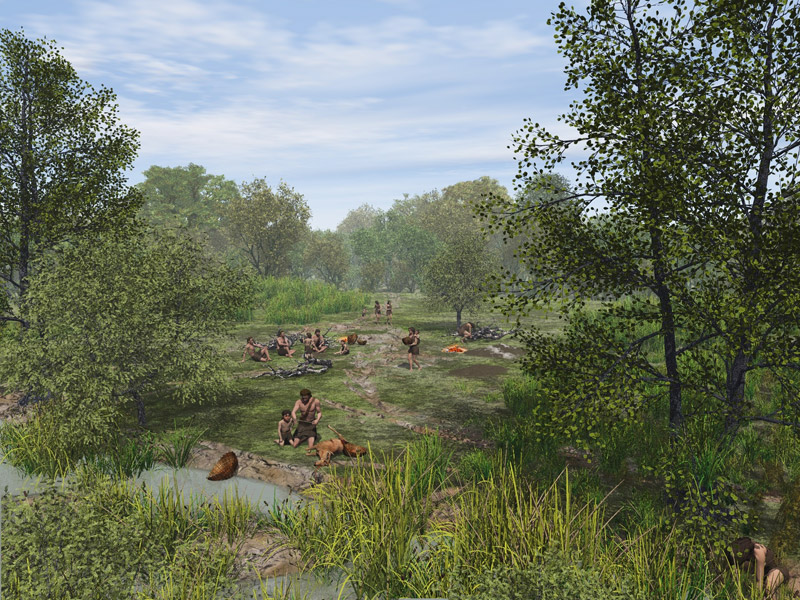
Mesolithic activity adjacent to a silted up stream channel in a forest clearing.

Mesolithic location
Between the end of the last Ice Age at 9,000 BC and the introduction of agriculture at around 4,000 BC, the inhabitants of the Heathrow landscape lived a mobile life, existing by hunting animals and gathering wild plants. The landscape for much of this period would have been heavily wooded, and it is likely that people lived in small family groups. From time to time during the year, these families would have met to exchange news, celebrate marriages and commemorate deaths. Negotiating agreements about access to the resources of the woodland and the Colne floodplain would have been an important element of these meetings.
We believe that a cluster of shallow pits containing burnt flint dated to the 8th to 6th millennia BC marks the location of one of these meeting places on the gravel terrace. The pits are located adjacent to a silted-up stream channel, a boggy area devoid of trees which formed a small, natural clearing in the forest canopy. We do not know exactly what activities led to the digging of the pits, but the burnt flints found in them suggest they may have been used for boiling meat for communal feasting. The waste bone and burnt flint from repeated visits would have accumulated to form a low rubbish mound or midden over time, lending the location an important historical meaning for the family groups who met there.
When we come to consider the construction of the Stanwell cursus in the fourth millennium BC, we will see that it incorporated the location of the Mesolithic burnt flint pits, and discover how the residual meaning attached to that location was transformed into something new.
In addition to the burnt flint pits on the gravel terrace were a group of stakeholes found at Bedfont Court on the river Colne floodplain, dated to c 6,000 BC, indicating that Mesolithic activity was widespread across a range of local environments.
4,200-3,600 BC A Clearing in the Woods

People working to extend a clearing in the woods, during the Neolithic

Neolithic Clearance
The introduction of agriculture around 4,000 BC seems to have little impact on the landscape, at least at first. However, around 3,700 BC the combination of human activity and Dutch Elm Disease led to a dramatic decline in the proportion of elm trees in the forest. It is likely that disease would lead to the opportunity for people to clear patches of dead or non-viable elms. The labour required for cutting down and uprooting mature trees is considerable, and this opportunity to create clearances in the forest would have required the different family groups to come together and co-operate on a formal basis. This act of labour would have strengthened the bonds between the families, and led over time to the creation of clearings for more extensive grazing of domesticated animals and the growing of crops. How the families responded to the opportunity presented by the elm decline had a direct effect on the landscape, but also the indirect effect of starting to build a stronger community. From now on, the family groups had to negotiate who, how and where they would exploit not only the natural resources of the landscape, but also the important clearings that they had created. One of the mechanisms they employed to do this was to elaborate the oral and ritual traditions of the past into ceremonies, and then to place those ceremonies within an architectural context. For instance, at two locations along the edge of the Colne floodplain were a series of timber posts, which may have functioned as totem poles. It is likely that each family group had a particular location or locations which were historically important to them, such as the Mesolithic bunt flint pits, where they hosted meetings and ceremonies for the leading members of the other family groups. It is possible that the ceremonies involved processing from place to place, and just such a route way seems to have linked the string of small monuments and settlements along the edge of the Colne floodplain. The remains of one possible settlement were found under the alignment of the later Stanwell Cursus at Heathrow.