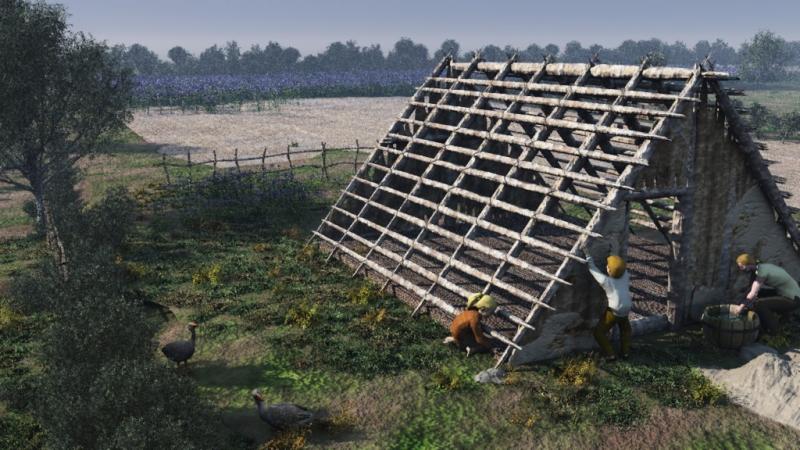
A Saxon family work on the construction of a building. Flax fields are visible beyond.

Following Britain’s exit from the contracting Roman Empire, the towns and cities, which had already been in decline during the later part of the Roman period, rapidly fell into disuse. Severed from the wider network of the Roman Empire the focus appears to return to the local scale and immediate landscape. However, processes were at work, which led to the emergence of Saxon society. At Heathrow a dispersed, drifting pattern of settlement seems once again to emerge, set within a sparsely occupied land. Excavations south of the medieval and present day village of Longford revealed a settlement of sunken-featured buildings, pits and postholes dating to the 6-7th century AD. People continued to cultivate the land, and also seem to have grown flax to provide linen and oil. Despite the dearth of evidence from the current excavations for the Middle Saxon period, the region in general saw the emergence of more stable settlement locations at this time, with increasing nucleation in the late Saxon period leading to the familiar pattern of villages and open fields. It seems likely that the excavated Saxon settlement eventually developed into the medieval village of Longford that we see today.
There is some discussion on the nature of this building. Saxon Grubenhausen are thought to have taken several forms. Some believe the internal pits were simply a form of moisture protection for a suspended floor. Others that the pit was also occupied in some way. Most reconstructions show houses faced with close boarding but here daub pits found on the site are interpreted as supplying the materials for the walls.
This image shows an alternative interpretation with low vertical walls.